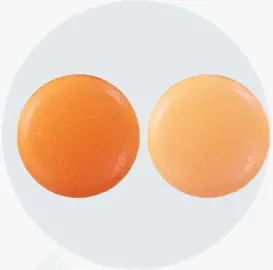
Achieving a flawless tablet film coating requires a delicate balance of thermodynamics, fluid dynamics, and polymer chemistry. Even a slight deviation in processing parameters can compromise film integrity, leading to costly batch rejections and regulatory concerns. Preventing these issues requires both a deep understanding of the equipment and the use of optimized, high-performance excipients.
Whether you are evaluating a new polymer system or troubleshooting an existing formulation, here are the five most common tablet coating defects, their scientific root causes, and how to prevent them using engineered solutions from ANSHCOAT.
1. Orange Peel (Surface Roughness)
The Problem: The tablet surface appears bumpy and matte, resembling the skin of an orange, rather than having a smooth, glossy finish.The Root Cause: Orange peel occurs when coating droplets dry too rapidly before they have time to properly coalesce and spread across the tablet surface. This is typically driven by high suspension viscosity, low atomization air pressure, or an excessively high drying temperature.
The Solution: Increase atomization air pressure to create finer droplets. If the issue persists, you must reduce suspension viscosity. Explore our comprehensive coating defect troubleshooting guide for specific spray rate diagnostics. ANSHCOAT’s high-solids systems maintain ultra-low viscosity even at high concentrations, ensuring perfect droplet spread without extending cycle times.
2. Twinning (Tablet Sticking)
The Problem: Two or more tablets stick together during the coating process and remain bonded after drying, resulting in a rejected batch.The Root Cause: Twinning is a mechanical and thermodynamic failure. It happens when the spray rate is too high (overwetting the tablet bed) combined with a pan speed that is too slow. It is also highly prevalent when using flat-faced tablet punches rather than standard convex tooling.
The Solution: Decrease spray application rate and increase pan rotation speed to ensure tablets separate before the polymer film dries. Use our free tablet coating solvent ratio calculator to balance solids content with thermodynamic evaporation rates. Upgrading to a fast-drying aqueous system drastically reduces the tacky phase of the polymer.
3. Mottling (Color Variation)
The Problem: The color distribution on the final tablet is uneven, exhibiting dark spots, light patches, or a marbled appearance.The Root Cause: Mottling is typically caused by poor pigment dispersion during suspension preparation, or the migration of soluble dyes during drying. It can also occur if the core is overwetted, causing moisture-sensitive ingredients to bleed through the film.
The Solution: Switch from soluble dyes to insoluble aluminum lake pigments and ensure high-shear mixing. Alternatively, utilize pre-formulated, fully dispersed colored premixes from ANSHCOAT tablet coating systems that guarantee absolute batch-to-batch color uniformity and spectrophotometric consistency.
4. Cracking & Peeling
The Problem: The film coating fractures (cracking) or completely detaches and flakes away from the tablet core (peeling).The Root Cause: Cracking is caused by internal macroscopic stress; the polymer film lacks elasticity to expand with the core during thermal changes. Peeling is an adhesion failure, often resulting from a highly friable core, excessive surface dust, or poor polymer binding properties.
The Solution: Improve the mechanical strength of your core formulation and ensure thorough de-dusting before spraying. From an excipient standpoint, the formulation requires an optimized ratio of plasticizers to improve flexibility—a built-in engineering feature in ANSHCOAT moisture barrier coatings.
5. Blistering
The Problem: Small bubbles or blisters form on the surface of the film coat, compromising barrier integrity.The Root Cause: Blistering is strictly a thermodynamic defect caused by the entrapment of gases or solvent vapors under the polymer film due to severe overheating during active spraying or curing.
The Solution: Implement milder drying conditions. Reduce inlet and exhaust air temperatures to prevent premature surface skinning, allowing vapors to escape evenly.
While fine-tuning machine parameters is essential, the permanent fix to recurring defects is utilizing a superior polymer matrix. ANSHCOAT provides specialized, ready-to-use coating systems engineered specifically to widen your processing window, enhance adhesion, and eliminate common defects. You can request trial evaluation samples to test performance directly on your manufacturing equipment.

13+ years in Tablet Coating Science. Expert in dissolution optimization, moisture barrier design, film uniformity, and advanced adhesion systems.